
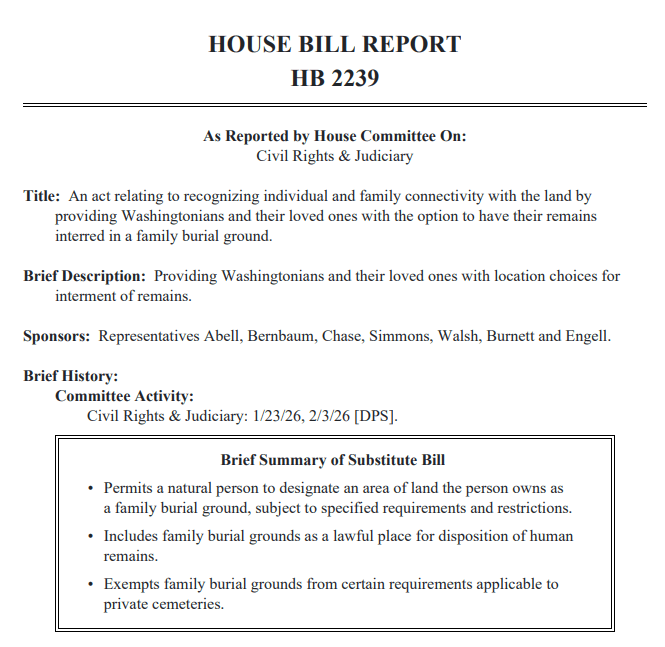
On March 24, 2026, Governor Bob Ferguson signed into law HB 2239: Providing Washingtonians and their loved ones with location choices for interment of remains. This bill legalizes the practice of establishing “family burial grounds” on privately-owned property without needing to register the property as a cemetery. Essentially, it allows for individuals to bury their deceased loved ones on their own private property. The bill goes into effect 6/11/2026.
This is a major win, particularly for rural Washingtonians, who wish for their body to lay to rest on their land or private land near and dear to them. Previously, burial was only an option at licensed cemeteries, which added a $5,000 price tag to that designation. Burial plots at licensed cemeteries can run anywhere from $1,000 to $20,000 per plot. This bill effectively ends the monopoly on cemeteries being the only place for burial services, giving the right to bury to Washington’s residents. HB 2239 also explicitly permits mausoleums and columbaria on the family burial grounds for interring cremated remains.
There are of course some restrictions laid out in HB 2239 that we’ll cover here, but for anyone seriously considering burial at a family burial ground, PMA recommends you read the text of the bill yourself:
Deaths still must be reported and death certificates must be issued. Death certificates require the signature of a doctor to pronounce death and list the cause. A county coroner or medical examiner may need to be engaged depending on the cause of death or circumstances around the death.
For more information about reporting a death, read PMA’s When Death Occurs Guide.“If a property is co-owned by two or more natural persons, a family burial ground may be established on the property only with the written consent of all co-owners of the property.” Quoted directly from HB 2239.
“A family burial ground may not be established on any property co-owned by a combination of natural persons and legal entities.” Quoted directly from HB 2239.
“A family burial ground must be set back at least 25 feet from an existing parcel boundary and may not be established… within 150 feet of a designated critical area, as defined in RCW 36.70A.030.” Quoted directly from HB 2239.
”’Critical areas’ include the following areas and ecosystems: (a) Wetlands; (b) areas with a critical recharging effect on aquifers used for potable water; (c) fish and wildlife habitat conservation areas; (d) frequently flooded areas; and (e) geologically hazardous areas. ‘Fish and wildlife habitat conservation areas’ does not include such artificial features or constructs as irrigation delivery systems, irrigation infrastructure, irrigation canals, or drainage ditches that lie within the boundaries of and are maintained by a port district or an irrigation district or company.” Quoted directly from RCW 36.70A.030.
A family burial ground may not be established “within 100 feet of the property line of a public right-of-way or boundary of an easement.” Quoted directly from HB 2239.
A family burial ground may not be established within 100 feet of an existing well source used for drinking or 200 feet of an existing spring source used for drinking water.
Lastly, “A family burial ground may not comprise greater than 10 percent of the area of the parcel upon which it is established,” avoiding the ability of someone to call a property primarily used as a burial site a family burial ground.
PMA's Executive Director Casey Husseman Brandt's comments on the bill’s passage
This is absolutely fantastic. Family owning land can now–with some restrictions to mind–bury their loved ones on their own property, establishing “family burial grounds” without needing to register their land as a cemetery. This removes an over $5,000 barrier to burying loved ones on their own land and decreases the price of burial to essentially a shroud or casket and a shovel.
This certainly affects rural residents more than urban residents, but as family burial grounds start to emerge across our state, perhaps some families will open their property up to distant relatives and urban neighbors. This is clearly meant as an affordable alternative to burying a loved one in a cemetery, where burial plots may cost anywhere from $1,000 to $20,000–and that’s without ceremony and service fees a cemetery charges for opening/closing the plot. I am greatly encouraged to see our state legislators expanding options to Washingtonians that are affordable and responding to the call of Washingtonians desiring to be buried on their own land.
Prior to this bill passing, Washington was one of only four states that did not allow burial on private property. This will hopefully allow families to have a more personal ceremony as they lay their loved ones to rest on the land they chose, and certainly lowers the price for burial services. Washingtonians must still report the death and receive a signed death certificate for each death that occurs in our state. Make sure to read PMA’s When Death Occurs Guide for more information about that critical time.